

Shahid Ahmed's unforgettable contribution to ChessBase India
For nearly a decade, Shahid Ahmed was an integral part of the backbone of ChessBase India. He wrote thousands of articles, conducted hundreds of interviews, and documented countless milestones in Indian chess. But numbers alone cannot capture the spirit with which he approached his work. 31st January 2026 was his last day with the company. Shahid is someone who genuinely cares about the game and the people who make it special. We wanted to look back at his journey and celebrate the work he has done over the years. A small tribute to someone who spent years documenting the achievements of others!
Impact without the spotlight!
In any sport, the spotlight naturally falls on the players. In the media side of things, it mostly falls on the faces in front of the camera. Whenever people asked me what I do and I mentioned ChessBase India, the usual reaction would be,”Oh yes, I know Sagar… Amruta.” For anyone who follows ChessBase India, the names of Sagar Shah and Amruta Mokal are naturally the first that come to mind. But every once in a while, someone would say something that would pleasantly surprise me. “Oh yes, I know Sagar, Amruta… and Shahid.” It was fascinating to see that people remembered Shahid so clearly, considering that he was not someone you would see in front of the camera. Yes, he conducted many interviews and wrote a zillion articles, but most of his work happened behind the scenes. It just proved that you don't need to be in the center of the frame to be remembered. You just need to care deeply about what you do, and do it with such consistency and heart that people eventually start to notice!

31st January 2026 was Shahid’s last day working with ChessBase India. I never had the opportunity to work closely with him or even have a proper conversation with him. Whatever image I have of Shahid today is shaped entirely by what I observed from a distance and what I heard from people who had worked with him over the years.
Sagar often used to describe Shahid as the “Mr. Consistent” of ChessBase India. Shahid usually used to write three articles a day. When I read ChessBase India’s eighth anniversary article, I noticed that it mentioned Shahid had written 1070 articles in a single year. I don’t know which number sounds more mind-blowing: three articles every day or 1070 in a year. Or perhaps the fact that he rarely took a break. You decide!
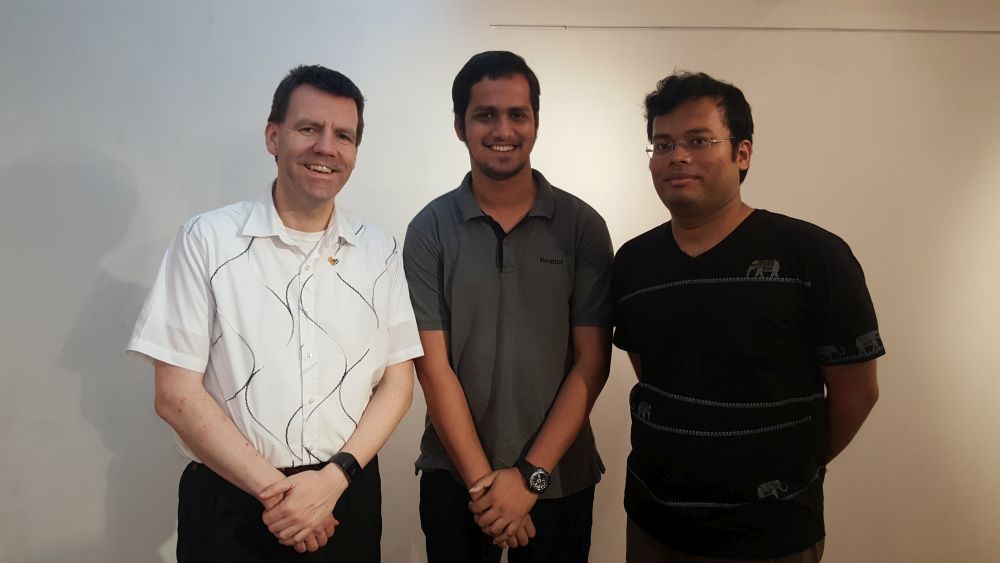
Shahid Ahmed’s journey with ChessBase India began in 2017, at a time when the team was exploring ways to organise online events on Playchess. Over the years, the nature of his work evolved constantly. He wrote articles, conducted interviews, edited videos, managed social media and handled many other responsibilities that kept the ChessBase India news desk ticking.
I met him for the first time at the FIDE World Cup 2025. I was there in the media room with him. It was pretty clear that Shahid was not a typical journalist. He had his own rhythm, his own style of working. In his usual professional attire, he sat in front of his laptop, completely focused on his work, almost oblivious to the noise around him. But the moment a major result seemed imminent, he would pick up his camera and microphone and head towards the playing hall, ready to catch the player for an interview. What struck me the most was how effortless he made it look. When speaking to players, Shahid was respectful and considerate. He often mentioned that one of the most important parts of conducting a good interview is understanding the player’s mood before asking questions. Knowing when to approach, when to wait, and when to step back is a skill that is easy to overlook but extremely important in journalism today.

Through his work, Shahid also made a conscious effort to highlight the achievements of Indian players. He wanted their stories to be told. In many ways, he became the person who ensured that these moments and achievements did not go unnoticed. For me personally, this helped a lot when I worked on the yearly recap articles. Shahid’s reports often became an important source of information. He always tried to present things with proper facts and statistics, making sure the information was accurate and reliable.
Chess for him has never been limited to reporting alone. He holds the title of Arena Grandmaster on the FIDE Online Arena. Interestingly, the competitive side of Shahid was visible even during the FIDE World Cup 2025. A small blitz tournament was organised for members of the media. Shahid went on to win the tournament with an impressive score of 4.5 points. For someone who spends most of his time writing about other players’ victories, it was a nice reminder that he could still produce a few winning games of his own!

Interview with Shahid Ahmed:
This article is also meant to reflect his own voice and perspective. So we sent him a few questions about his journey with ChessBase India, his writing process, and the philosophy that shaped his work over the years. Here is what he had to say:
Q. When did your journey with ChessBase India begin? And how did it begin?
A: I think it was around January 2017 when we (me, my mom and IM Neeraj Mishra formed chesspert.com) organized our first Rapid Open tournament titled - 1st Queen's Gambit Rapid Open. I used to suggest a lot of things/areas where ChessBase India could improve, try. At that time youtube channel had not started yet. So before Sagar went for the FIDE World Cup 2017 in Tbilisi, Georgia, I told him, now is the best time to start doing various videos - interviews, sit-down interviews, food and venue tour, etc.
Q: Do you remember your very first article for ChessBase India? What was it about, and how did it feel to see it published?
A: I think the article I sent above was the first one. It definitely was a great feeling because I was following chessbase.com reports almost daily from 2011 to that point, because I used to get plenty of time while I worked at The Heritage School as a chess teacher. Getting published on chessbase.com was a dream, felt virtually impossible, the closest thing was chessbase.in. So yeah, getting published on chessbase.in felt fantastic back then. It was a dream to work for ChessBase, since that felt out of reach/virtually impossible; joining ChessBase India was another dream. So getting published was the first small dream which was achieved.
Q: When you began writing regularly, did you ever imagine you would go on to write over 5000 articles?
A: Honestly, yes, I definitely thought that yes I will write forever. So 5000 or maybe it was close to 10000, I don't know, it's is a small number to me. These were not difficult to achieve for me, especially considering the fact that chess players in India are doing well at all stages, and organizers are regularly holding plenty of tournaments all over the country. So once the pandemic was over, I did not have to worry about what to write or about whom. It all became just a matter of time and things just fell into place. It's like the popular saying - it is a wonder how everything that happens on the previous day fits perfectly into a newspaper (although these days, newspapers are mostly full of ads and less news)
Q: Were there any days when you were not able to write an article? What's the secret of your consistency? What kept you going on days, even when you didn't feel like writing?
A: Yes, probably either I was travelling, or I was so sick that I could not gather enough energy to switch on the laptop and write something coherent. That probably happened less than five times during my tenure. I believe consistency in anything is the key to becoming the best. I always like the fact that the person who does not even know whether their triumph will be talked about, apart from their family and loved ones, is being written on a website that is read by a beginner to a World Champion. I have probably not met more than 50% people I have written about and probably never will, but that's alright, if I wrote something about them, and that brought a positive change in their life, that is good enough.
Q: Which is your favourite article or series of articles that you have done on ChessBase India?
A: I have too many to mention. It's just difficult to single out any one of them. I think I will leave it up to the readers to decide which one they liked or disliked.
(Editor's note: One of Shahid’s memorable series on ChessBase India was based on the popular Netflix show The Queen’s Gambit, where he explored the chess ideas and positions featured in the series.)
Q: You have worked on many different things in ChessBase India - writing articles, interviews, video edits, maintaining the calendar, social media and many more. Which one did you like the most?
A: I obviously loved interviewing people the most. I have interviewed players from almost every sphere of chess - from World Champion to beginners. I like the fact that an interview makes an impact or watched by a lot of people. I think in 2023 and 2024, I had at least one interview of Carlsen and Nakamura, which reached 100K+ views on just YouTube alone. I like the fact that a few months after my interview with IM Laura Unuk (SLO) at the end of the 44th Chess Olympiad 2022, she became the brand ambassador of Ford Slovenia.
Some time after my interviews with IM Nurgyul Salimova (BUL) at FIDE Women's World Cup 2023, she became Brand Ambassador of United Colors of Benetton Bulgaria.
Of course, I am not saying that my interviews played a key role in them becoming the brand ambassador. My point is, I want to show the side of chess players that I know or learned through meticulous research. Whatever good comes out of it is the players' acknowledgement, which I firmly believe they will get.
Q: You have always focused on giving the limelight to all the players in the chess ecosystem rather than focusing on top players or players that draw eyeballs. Was there a life episode that made you feel this was important?
A: I have told Sagar this. Kolkata was the heartbeat of chess in India long before the rest of the states caught up. For a long time, maybe a decade, the Goodricke GM tournament was the only GM tournament in India. It was a Semi-Open GM tournament. There I saw Viktor Korchtnoi, Vladimir Akopian, Nigel Short, Viktor Bologan and also Dibyendu Barua, Surya Sekhar Ganguly, Sandipan Chanda, Neelotpal Das and Sasikiran Krishnan in action. Every day at the end of all rounds, players were given a bulletin in the form of a small book which consisted of all the games of that round. After fulfilling my role as a board demonstrator (For the younger generation, those who watched Queen's Gambit mini-series will understand what it used to be), I used to storm to the third-floor office and save the games which concluded. Some of the scoresheets used to be in different languages. So before learning foreign languages, I learned foreign notations. It actually allowed me to see all 40-50 games, which used to take place in each round. Apart from the top boards, no one was interested in writing about the boards where the result was insignificant towards the tournament standings.
The same thing happened at the Telegraph Schools' tournament. No one even wants to write the results after a certain number, say 10 or 15. This was before the chess-results era, so a lot of people did not even get to know if anything interesting/exciting happened at the back. I obviously felt that I could bring a change to this. So whenever I go to a tournament, it absolutely does not matter to me who is playing at the top and bottom. If I see something interesting, I will either photograph the player(s), position, record their game, and maybe interview the players. Throughout my tenure, you will see there are fantastic videos on fb and yt where you would not know the players but they produced either a high-quality game or an entertaining one.
Q: How did this long writing journey shape you personally beyond chess and journalism?
A: Basically, I am an introvert. I always respect people's boundaries. So I approach a player carefully when I feel they might be willing to talk about their experiences. If they say no, feel tired. I understand and do not push. Plenty of people appreciated that I never force anyone for an interview or push too hard, I take no very easily. To me, the players' comfort is more important than getting an interview. Even if I get none, that is alright for me because for the player, the stakes are quite high. They probably have a lot of time, energy and money for the event and who knows, they might feel that the interview will do no good for them. So that's why I try to do as much research as possible before the interview and try to make sure the player as well as the viewer can also enjoy. It should be worth everyone's time.
Q: In your opinion, what makes a truly good chess article?
A: Facts and statistics. Story can be told by anyone, even AI can generate a story. But it takes real effort to find the facts and statistics, tell the things that need to be told instead of conjuring up word salad and creating a nothing burger.
Q: What advice would you give to young writers who want to contribute to chess media?
A: Always get the facts and statistics right. If English is not your first language like mine, a little grammatical error can be passable as long as the meaning that you want to convey does not change. Also, try to focus on all players because a tournament is successful based on how many players, whom you do not even know, have managed to attract by using the known players' status and presence, among other factors.
Q: Anything else you would like to add?
A: I do not know. I have met and interacted with a lot of people, which I liked - the greatest chess commentator, GM Peter Leko. I will never forget my conversation with him in Prague in March 2025, from watching GM Anna Muzychuk and GM Vasyl Ivanchuk winning World Rapid and Blitz Women Gold, and World Rapid Gold in 2016 on youtube (my first chess event followed live on youtube) to watching them in action nine years later at World Rapid and Blitz 2025 was a super special thing to me, asking Hikaru Nakamura about a potential Nakamura vs Nakamura match at a WrestleMania at Global Chess League 2024 and plenty of memorable moments. Some are just my memories.
Let chess prevail in a world full of distractions, destructors and derogators. It is very easy to follow a trend but difficult to create one. So try to inspire and do the right thing in times where doing the right thing is not so common and obvious.
- Shahid Ahmed

Related News

What’s New on the ChessBase India Website?

Meet Purvansh Shah: An Emerging Chess Talent who Dreams of Becoming the Youngest World Champion

Mentors Needed: Help Checkmate Betul Bring Chess to Girls Across India

"If You Want a GM Norm, Beat a GM" : Michal Krasenkow

Rithvik Marri - The boy who challenged the world to created his own

Mumbai boy Jaiveer Mahendru's sensational wildcard entry to the Abu Dhabi Masters

ChessBase India hits 1 million subscribers on YouTube! + winners of giveaway announced

Your chance to play at DreamHack Rapid and Blitz with a prize fund of Rs.10 lakh

The people who keep ChessBase India going

Five years of Powering Chess in India